Digitek LED-D130 RGB Video Light
Complete Hardware Teardown & Technical Analysis
1. Product Overview
The Digitek LED-D130 RGB is a 12W portable RGB video light designed for photography and videography applications. It targets content creators by combining RGB effects, bi-color white light, compact form factor, and battery operation.
Key Features
- Power Output: 12W
- Total LEDs: 135 LEDs
- Color Temperature: 2500K – 9900K
- Color Control: HSI 360°
- Effects: 21 FX modes
- Brightness Control: 0–100%
- Battery: 4000mAh built-in Li-ion
- Mounting: 1/4” screw mount
- User Interface: Rotary encoder + monochrome OLED
- Charging Interface: USB Type-C
2. LED Architecture & Optical Design
LED Configuration
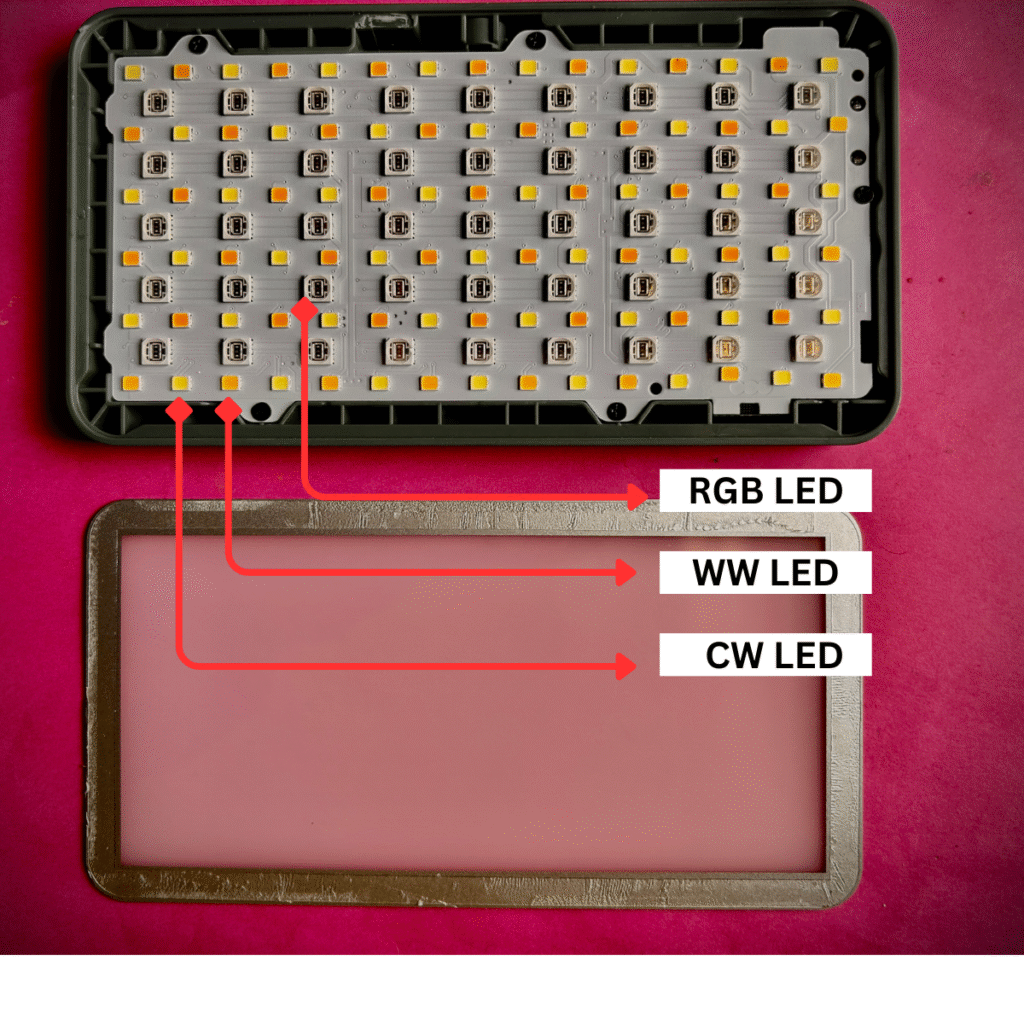
- 45 RGB LEDs
- Cool White + Warm White LEDs arranged in a 15 × 6 matrix
- Total LED count: 135
All LEDs are mounted on a single aluminium-core PCB (MCPCB).
Why Aluminium PCB?
- Efficient heat spreading
- Improved LED lifetime
- Mechanical rigidity
- Compact stacking without external heat sinks
Optical Diffusion
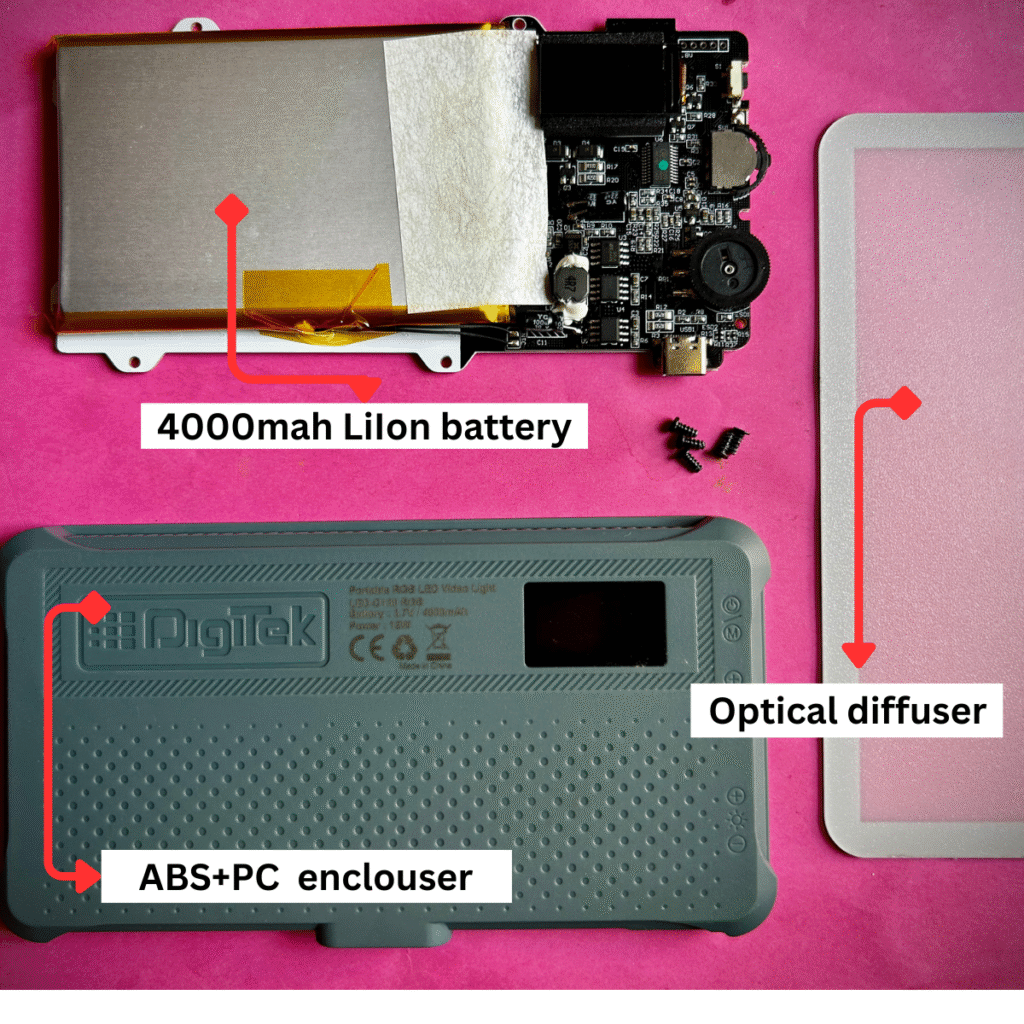
- A dedicated optical diffuser plate is placed above the LED array
- Purpose:
- Uniform light distribution
- Reduced hotspots
- Softer shadows for video use
3. Power System & Battery Management
Battery
- Single-cell Li-ion battery
- Capacity: 4000mAh
- Nominal voltage: 3.7V
The battery is mechanically isolated using foam insulation to prevent:
- Heat transfer from LEDs
- Vibration damage
- Electrical short risks
Charging & Power Input
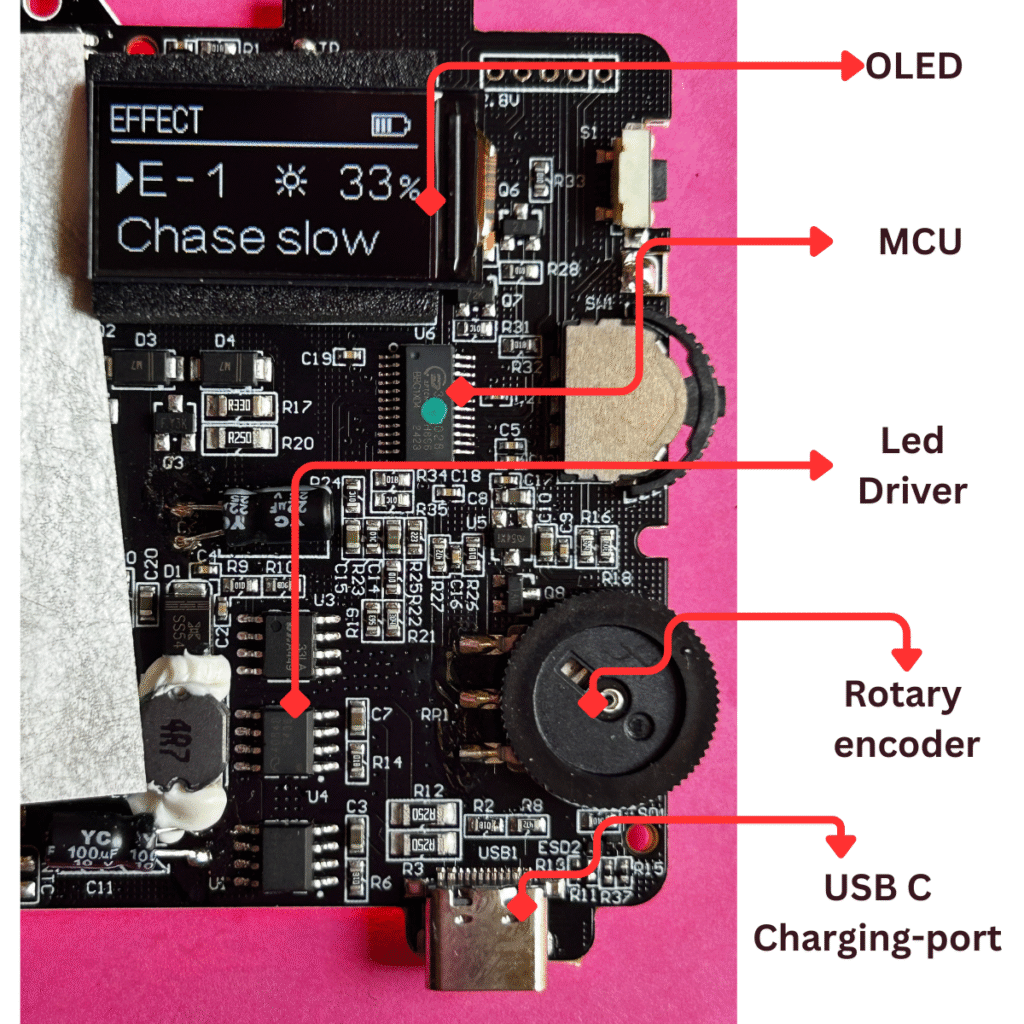
- USB Type-C charging port
- 5V input (non-PD)
- Dedicated battery charging and protection IC
- Over-charge protection
- Over-discharge protection
- Short-circuit safety
4. LED Driver & Power Electronics
- Inductor-based switching power stage
- Likely buck / boost topology
- Provides constant current drive to LEDs
- PWM dimming used for:
- Brightness control
- FX modes
- Color mixing
This approach ensures:
- High efficiency
- Stable brightness across battery voltage range
5. Control & Processing Unit
Microcontroller (MCU)
- Package type: QFN / TSSOP (compact SMD package)
- Responsibilities:
- LED control logic
- FX mode generation
- PWM dimming
- Battery level monitoring
- User input processing
- OLED display control
The firmware appears to be fully MCU-driven, with no external memory.
6. User Interface Hardware
Display
- Monochrome OLED display
- Displays:
- Brightness percentage
- Color temperature / FX mode
- Battery status
Chosen for:
- High contrast
- Low power consumption
- Thin form factor
Input Controls
- Rotary encoder with push switch
- Enables:
- Smooth brightness adjustment
- Menu navigation
- Mode selection
7. Mechanical Design & Enclosure
Enclosure Material
- Main body: ABS+PC (PC-ABS) plastic
- Rear grip area: Silicone / rubberized cover
Design Benefits
- Lightweight and impact resistant
- Good thermal insulation for battery
- Cost-effective injection molding
- Improved handheld ergonomics
8. Thermal Management Strategy
- Passive thermal design
- Aluminium PCB spreads LED heat
- Foam insulation protects battery
- No active cooling or metal enclosure
This design indicates:
- Controlled LED drive currents
- Focus on efficiency over raw brightness
9. Manufacturing & System Integration Insights
- Single main PCB for:
- MCU
- Power electronics
- Display interface
- User controls
- Minimal interconnects
- Compact BOM
- High assembly repeatability
Despite the compact size, the internal design shows strong system-level integration without unnecessary complexity.
10. Engineering Takeaways
- Creator lighting is not just LED placement
- Requires integration of:
- Power electronics
- Embedded firmware
- Thermal design
- Optics
- Mechanical packaging
- This complexity explains why the segment is still dominated by established brands rather than early-stage startups
Conclusion
The Digitek LED-D130 teardown highlights how a seemingly simple consumer product hides multi-disciplinary engineering challenges. From aluminium PCBs and LED drivers to firmware-controlled UX and battery safety, this device serves as a strong reference design for anyone exploring battery-powered lighting products.