Teardown Observation – Tive Solo 5G Tracker
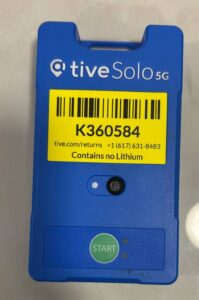 Recently, I got a chance to explore the Tive Solo 5G GPS Tracker, and I must say, the device has a very impressive form factor, rugged aesthetics, and compact design – clearly built for logistics and supply chain applications.
On opening the unit, here’s what I observed:
 Rugged Enclosure
Sturdy plastic housing designed to withstand industrial handling and rough logistics environments.
Clearly marked START button for easy activation, keeping usability simple for operators.
Label indicates “Contains no Lithium”, which is crucial for air shipments and global compliance with transport regulations.
 Connectivity Module
The core of the device is powered by a Quectel EC200U-CN LTE module.
This is a 4G LTE Cat 1 bis cellular module, optimized for IoT applications.
Integrated GNSS (GPS/BeiDou/GLONASS) ensures precise location tracking.
Quectel modules are well-known for low power consumption and high reliability – a strong choice for always-on tracking.
 Battery Choice – 3-cell NiMH (2200 mAh)
The device uses a Nickel-Metal Hydride (NiMH) 3-cell pack (2200 mAh) instead of Li-ion.
Why NiMH and not Li-ion?
 Air-transport safe → No lithium restrictions, compliant with IATA regulations.
Temperature resilience → Performs well across wider temperature ranges.
Safety → No risk of thermal runaway/explosion, unlike Li-ion.
Good cycle life → Rechargeable with decent energy density.
 MCU & System Design
I wasn’t able to clearly spot the main MCU during teardown – it seems to be under the metal shielding plate.
Based on the application, it’s likely to be a low-power ARM Cortex-M series (STM32 / NXP Kinetis / Nordic), handling sensor data + communication with the Quectel modem.
If anyone from the community has insights into which MCU Tive typically uses, I’d love to hear your thoughts.
 Other Design Observations
Likely includes accelerometer, temperature, and motion sensors for shipment condition monitoring.
Internal cellular + GNSS antennas are integrated into the compact enclosure.
A return program (printed on the label) reflects Tive’s commitment to sustainability and device reusability.
